Wednesday, March 21, 2012

Army asked to keep troops at Preah Vihear

Bangkok Post
March 21, 2012


A Thai territory protection network has demanded that the Second Army pledge not to withdraw troops from disputed land near the Preah Vihear temple.
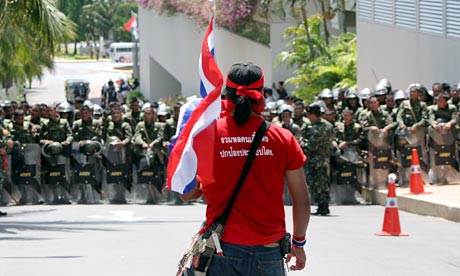
Some 100 activists from the Alliance to Protect the Land in the Lower Isan and the East yesterday submitted a petition to the Second Army demanding it not to pull troops from the disputed area on the Thai-Cambodian border as ordered by the International Court of Justice.
The network claimed their members have surveyed several parts around the disputed 4.6-square-kilometre area and found some have been occupied by Cambodian troops and civilians. The group also inquired about the army's progress in solving border disputes which pose a risk to Thailand's territorial integrity. The activists have given the army two weeks to respond to their inquiry, Dr Pratheep Talapthong, the network leader, said.


Sunday, March 18, 2012

Waiting for RI observers at Preah Vihear

The Jakarta Post
March 17, 2012
onathan Prentice, Brussels
profimedia-0090299215.jpg

CAMBODIA-PREAH VIHEAR-SOLDIERS

(110210) -- PREAH VIHEAR, Feb. 10, 2011 (Xinhua) -- Cambodian soldiers stand next to their weapons in the border disputed areas near the Preah Vihear Temple, Feb. 9, 2011. Cambodian troops were dispatched to the areas near the Preah Vihear Temple. After several days of hostilities the disputed Thai-Cambodia border is now quiet. But while the two countries are talking peace, they are also preparing for more fighting. At the heart of the conflict sits the ruins of Preah Vihear temple, an 11th century gem of classical Khmer architecture. The dispute may bring the two countries to the brink of war. For the moment, a ceasefire is holding, and both sides say they want to avoid further conflict. (Xinhua/Phearum) (lyi).  


A year ago, Cambodia and Thailand fought a series of short but nasty skirmishes along their joint border. Efforts to reduce tensions through the deployment of Indonesian observers remain stillborn; one year on there are no observers and on the Cambodian side there is just a lone man with Indonesian and ASEAN flags blowing in the breeze.

The dispute, centered on the emblematic Preah Vihear Temple — in Cambodian territory but down the years oft-claimed by Thailand — was serious enough to seize the attention of the UN Security Council. 

It also triggered signs that ASEAN wanted a more proactive role in ensuring stability in its region. This optimism, however, has given way to stasis and further questioning of the organization’s ability to look after its own backyard.

Earlier this month, I met an official from Cambodia’s National Task Force whose job is to prepare the ground for the observers’ arrival. 

After I traveled four hours north from Siem Reap, home of the famous Angkor ruins, he picked me up in his new Mitsubishi flat bed with ASEAN logo decals and license plate: IOT 3.

IOT is for Indonesia Observer Team. Under the terms of reference signed by Cambodia in May 2011 ahead of the ASEAN Summit in Jakarta, there were to be 15 Indonesian soldiers and civilians on either side of the border.

Thailand has not signed the agreement and it never came into force. Then foreign minister Kasit Piromya initially announced Bangkok’s agreement to the observer mission’s deployment but objections from the military caused the historic deal to falter. 

First, Thailand quibbled over the team’s location, their name, their diplomatic status and what they would wear. Then Thai generals said they would not accept Indonesian soldiers in uniform on their soil as it was an affront to their sovereignty.

A special meeting convened by President Susilo Bambang Yudhoyono on the sidelines of the summit could not remove the roadblock. A July 2011 decision of the International Court of Justice ordering their deployment was ignored. 

The narrow interests of the Thai military trumped ASEAN’s potential collective goal of coming up with a working mechanism to deal with violent conflict within its own membership.

Back in Cambodia’s far north, on the border near Preah Vihear, bored Cambodian soldiers stare across the valley at their Thai counterparts; who seem, likewise, to have little else to do but in turn stare back. To occupy their time they eat, sleep, converse, play cards; it is too brutally hot to exercise. Some say they just want to go home.

After visiting the World Heritage temple site, we visited the empty headquarters of the ASEAN Mission for Cease-Fire Observation. The red and white Indonesian flag is everywhere. Had the Indonesians arrived, I asked? 

No. What did my guide do all day? He waited for the Indonesians, was the response; he did not expect them anytime soon. This poor fellow, originally from Kompong Cham, Cambodia’s border province with Vietnam many miles away, was like a sad facsimile of a character from a Conrad novel — sent out to the back of beyond by his bosses and, perhaps, forgotten.

A few days after my visit, on March 5, Cambodian Foreign Minister Hor Namhong and his Indonesian opposite number Marty Natalegawa met in Phnom Penh and reportedly discussed the IOT, but most officials in the capital seemed to want to forget about this problem in the year that is Cambodia’s turn to chair ASEAN, and as Phnom Penh’s efforts to secure a temporary seat on the UN Security Council intensify. Such is his life that my friend from the National Task Force waits for something that may never arrive. 

But even if they were deployed, the observers would only solve part of the problem, as their area of operations only covers Preah Vihear and its environs, particularly the almost 18 square km provisional demilitarized area created by the ICJ decision.

 Around 150 km to the west, troops from both countries face off against each other around the more obscure temples of Ta Moan and Ta Krabei. They are heavily armed, well dug-in, and so close that at Ta Moan they even share the same shade from the trees. 

This is not sustainable — it is simply too risky that firefights could be triggered, even if only accidentally. Visiting Ta Moan, it was difficult to accept that Thailand and Cambodia, under the ASEAN umbrella, had sworn undying friendship toward each other.

The world’s focus has shifted elsewhere, but here on this disputed frontier the conflict continues. The week before my visit gunshots terrified the residents of a nearby town; they turned out only to be soldiers shooting harmlessly into the air — last year’s fighting suggests such noises might not always be so benign.

But rather than wait for the conflict to reignite and cause problems again for Cambodia, Thailand and ASEAN, there is a first step that could be taken toward preventing future misunderstandings and violent conflict — deploy the observers. 

The flags are flying, the maps are posted, vehicles are fueled and, on the border, there is a lonely Cambodian official ready and waiting to provide a welcome.

The writer is the senior policy advisor at the International Crisis Group based in Brussels. 

Friday, March 16, 2012

The Great Khmer Empire

I couldn't get the Khmer fonts to work on my video. Sorry!!


Pheu Thai members head to Cambodia to meet Thaksin

columnistBangkok Post
March 16, 2012
Aekarach Sattaburuth
 

Former premier Thaksin Shinawatra has arrived in Cambodia to visit the sick father of Prime Minister Hun Sen, said a Pheu Thai Party source.
Many members of the Pheu Thai Party have flown to Cambodia to meet Thaksin, the source added yesterday.
Thaksin will tour countries in the region for a while before returning to Dubai in the United Arab Emirates, where he lives in exile. Thaksin was spotted by reporters at Phokeethra Golf and Spa Resort in Siem Reap. He was accompanied by former Thai Rak Thai executive Yongyuth Tiyapairat, red shirt leader Suporn Attawong and National Parks, Wildlife, and Plant Conservation Department chief Damrong Pidech.
Noppadon Pattama, Thaksin's legal adviser, said it was normal for Pheu Thai members to make a trip to see Thaksin when he arrived in a neighbouring country for a visit.
Mr Noppadon insisted Thaksin's stay in Cambodia has no political motive. Now is not the time for any major reshuffle of the cabinet or government officials, he said.
Somkid Barnthaisong, Pheu Thai MP for Nong Khai, said Thaksin would be in Laos from April 13-15 to celebrate the Songkran festival.
Meanwhile, Sunai Jullpongsathon, chairman of the House committee on foreign affairs, said he and members of his panel may meet Thaksin while his panel spends time in Cambodia.
The committee reportedly decided to visit Cambodia instead of Myanmar this week following reports that Thaksin was expected to head to Cambodia.
It was reported that members of the committee who will travel to Cambodia from today until Sunday were members of the Pheu Thai Party.
Mr Sunai said earlier it was cheaper to go to Cambodia instead of Myanmar.
He said the aim of his visit to Cambodia was to meet Veera Somkwamkid, the coordinator of the Thai Patriots Network, and his secretary Ratree Pipattanapaiboon, both of whom are imprisoned in Phnom Penh for espionage and illegal entry into Cambodia. They were arrested in late December 2010.
The Foreign Ministry has said it wants to negotiate with Cambodia on a prisoner exchange deal to bring the activists home. Veera is reported to be in ill health.
Mr Sunai said the panel's visit would help foster bilateral cooperation to improve public health for residents on the common border.


PDZ ‘adjustment’ nixed

The Phnom Penh Post
Cheang Sokha
Thursday, 15, March 2012

Cambodian government officials yesterday flatly ruled out any suggestion of renegotiating the Preah Vihear Provisional Demilitarised Zone boundary as suggested by Thailand’s most senior military commander.

Thai Supreme Commander Thanasak Patimapakorn told the Nation newspaper over the weekend that Thailand would discuss with Cambodia the prospect of renegotiating the boundaries of the 17.3-square-kilometre PDZ established by the International Court of Justice in July.

“The world court has marked the demilitarised zone, but now that both countries have good relations, we think we can discuss the matter first,” he was quoted as saying. 

“We don’t know who has set up the zone or who determines where the ABCD points are located. So if we can talk with Cambodia, we can live together peacefully,” Thanasak reportedly said.

Foreign Affairs spokesman Koy Kuong said yesterday Cambodia remained committed to withdrawing troops from the PDZ in its current configuration to make way for Indonesian border observers, as prescribed by the ICJ ruling in July. 

“We do not have any idea for an adjustment as has been raised by Thailand,” he said, adding that Thailand could take the suggestion to the ICJ if it pleased.

Koy Kuong said that if a pending ICJ ruling over the 4.6-square-kilometre dispu-ted area surrounding the 11th-century temple found in favour of Cambodia’s claim, development could proceed without Thailand. 

“We cannot take a house, which is our own possession, and let other people jointly manage it,” he said. 

Last April, Cambodia asked the ICJ to issue an interpretation of its 1962 decision that ruled in favour of Cambodia’s claim to the Preah Vihear temple following fierce clashes over the temple in February and April that left at least 28 people dead.

There has now been almost nine months of back-and-forth negotiations since the ICJ ordered both sides to “immediately” withdraw their forces from the PDZ in July in response to those clashes. 

Defense Minister Tea Banh yesterday stressed that the “most important thing” now was to implement this decision. 

“So far, we have not yet implemented the ICJ order, and we are pushing to implement it,” he said. 

“The obstacle for us on the withdrawal of troops from the demilitarised zones is that we [Cambodia and Thailand] have not yet set an agreement on when to do it.” 

Political analyst Lao Mong Hay said Cambodia had not been pressing that hard for the withdrawal, perhaps acknowledging that  relatively new Thai leader Yingluck Shinawatra faced internal resistance to such moves. 

“I think perhaps it’s a reflection of the hard-line position on the part of the Thai army. I think politically, it’s okay with Cambodia, but I think the [Thai] military do not pull the Thai government line,” he said. 

Yingluck Shinawatra’s older brother Thaksin, who was deposed as Thai prime minister in a 2006 military coup, has recently weighed in on the debate, suggesting Thailand would likely be defeated at the ICJ, a result that could fuel divisions in the politically unstable country.